
Blog
What Is an After-the-Fact Remodel in Florida?
Remodeled without a permit in Florida? Learn how after-the-fact permits work, what inspectors check, and how to legalize your remodel in 2026.
Key Takeaways
-
Applying for an after-the-fact permit does not guarantee approval; the building official may require as-built plans, inspections of hidden work, code corrections, and separate trade permits before closing the permit.
-
Stop any ongoing unpermitted work immediately, since continuing can increase resolution costs and penalties such as citations of up to $500 per violation in some counties like Hillsborough.
-
There is no single statewide ATF permit process, so confirm which city or county building department has jurisdiction and follow its specific forms, fees, and timelines.
-
Document everything performed, including electrical, plumbing, mechanical, and structural changes, and gather photos, receipts, and contractor details to support your application.
-
Inspectors cannot approve work they cannot see, so be prepared to expose concealed wiring, plumbing, or framing, though photos, small inspection openings, or engineer letters may reduce demolition.
-
Unpermitted remodels can surface during home sales, appraisals, refinancing, or insurance claims, so reviewing the permit history early in a transaction helps avoid last-minute surprises.
Picture this: you bought a lovely Florida home, and somewhere along the way you discover that the kitchen remodel the previous owner bragged about never had a permit. Or maybe your contractor finished the bathroom, collected the final check, and left you wondering whether anyone ever pulled paperwork. Take a deep breath. You are not the first person to land here, and there is a well-worn path out of it.
An after-the-fact remodel in Florida is a remodel that was started or finished before the required building permit was obtained. The good news is that building departments across the state have processes for bringing that work into compliance. The less-fun news is that those processes vary quite a bit by city and county, and approval is never automatic.
In this friendly guide, we will walk through what after-the-fact (ATF) remodel permitting really means, what the law says, what inspectors typically look for, and how to move forward without panic. Whether you are a homeowner, a general contractor, a realtor, or an investor, you will leave with a clear game plan.

What Does After-the-Fact Remodel Mean in Florida?
In plain English, an after-the-fact remodel permit is a request to a local building department to review and approve work that was begun or completed without the permit it needed. Think of it as asking the county to check your homework late. The work gets reviewed, inspected, and, if it passes, officially recorded.
Here is the part that surprises people: there is no single statewide ATF permit category with one uniform application. The building department that has jurisdiction over your property sets the procedures, paperwork, and fees. That is why a Tampa homeowner and a Miami homeowner can have noticeably different experiences with the same kind of unpermitted remodel.
If you want a deeper dive into the basics, our guide on what after-the-fact permitting in Florida involves is a great companion read.
What Florida Law Says About Permits for Remodeling
Florida Statutes §553.79(1)(a) generally requires a permit from the appropriate enforcing agency before constructing, altering, modifying, repairing, or demolishing a building. In other words, the statewide rule is permit first, build second. Because statutes get updated, it is smart to confirm the current language and any local amendments before you rely on it.
Whether a particular remodeling task needs a permit depends on the scope of work and your local rules. As a general pattern:
- Often treated as cosmetic: painting, some flooring, and swapping cabinet fronts, though local rules differ.
- Typically permitted: structural changes, moving or removing walls, new electrical circuits, plumbing relocations, and mechanical or HVAC work.
- Often permitted: window and door replacement, roofing, and changes that affect egress or fire safety.
When in doubt, a quick call to your building department or a permitting professional settles the question before it becomes a headache.
Common Remodels That End Up Needing an ATF Permit
Over the years, certain projects show up again and again in the ATF world. Here is a quick table to help you spot where trouble tends to hide.
| Remodel Type | Why It Often Lacks a Permit | What Reviewers Usually Care About |
|---|---|---|
| Kitchen remodel | Treated as "just cabinets" but includes electrical and plumbing changes | Circuit protection, outlet placement, venting, plumbing connections |
| Bathroom remodel | Fixtures moved without a plumbing permit | Drainage, ventilation, GFCI protection, waterproofing |
| Wall removal or addition | Assumed to be non-structural | Load path, headers, engineer verification |
| Garage conversion | Done as a quick living-space upgrade | Egress, insulation, electrical, HVAC, floor conditions |
| Window and door changes | Replaced like-for-like without paperwork | Wind rating, product approvals, proper installation |
If your project is on this list, you are in very good company. Plenty of Florida owners have walked this road, including those dealing with an unpermitted kitchen remodel or a bathroom job that skipped the paperwork.
Important Truth: An ATF Permit Does Not Automatically Legalize the Work
Here is the one thing we want you to remember above all else. Applying for an after-the-fact permit does not guarantee approval. The local building official may require plans, supporting documents, inspections of completed and hidden work, corrections to code deficiencies, and separate trade permits before approving the project or closing the permit.
So the real question is not whether you can file. It is whether the existing work can be shown to meet the Florida Building Code. If it can, great. If it cannot, corrections come first. That is exactly why having an experienced team in your corner pays off.
How the After-the-Fact Permit Process Typically Works
Every jurisdiction has its own quirks, but most ATF remodel applications follow a familiar rhythm. Here is a practical step-by-step outline you can use as a starting point.
- Stop any ongoing work. If the remodel is still underway without a permit, pause. Hillsborough County, for example, advises stopping immediately and contacting Building Services, and it warns that continuing can increase resolution costs.
- Identify your jurisdiction. Confirm whether the city or the county reviews your property. Our building department lookup tool can help you find the right office.
- Document everything that was done. List each task, including electrical, plumbing, mechanical, and structural changes, and gather photos, receipts, and contractor details.
- Prepare plans or drawings. Many departments want as-built drawings or an engineer letter showing the work as it exists today.
- Submit the application and pay fees. The department reviews, approves, and requires payment of applicable fees before issuing the permit.
- Schedule inspections. Inspectors check completed work and may ask to see concealed areas.
- Correct any deficiencies. Fix whatever the inspector flags, then request reinspection.
- Get final approval. Once everything passes, the permit is closed out and your record is clean.
Because timelines and costs are jurisdiction-specific, avoid anyone who promises a fixed price or turnaround before checking your local rules.
Will Inspectors Make You Open Walls or Ceilings?
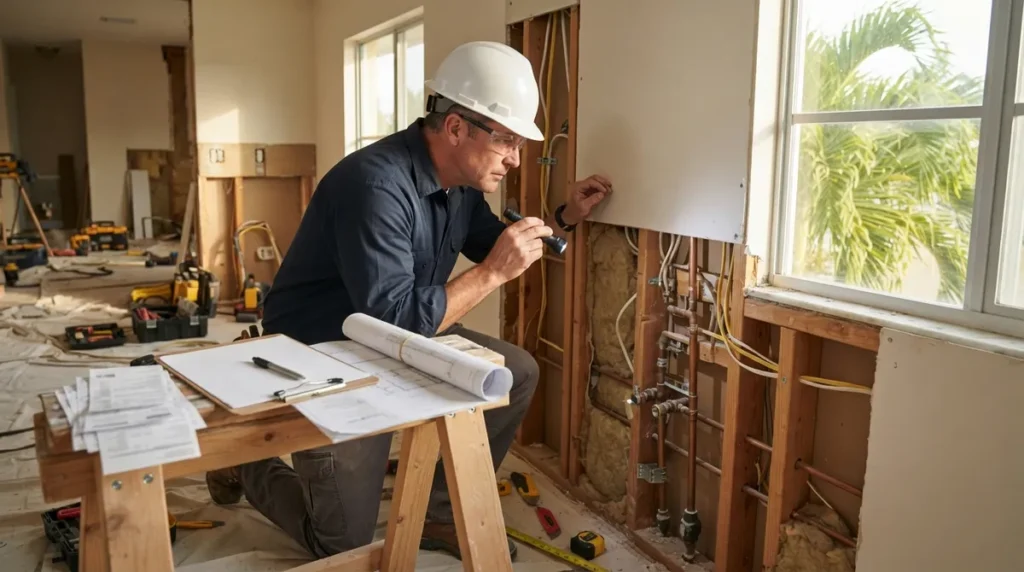
This is one of the most common worries, and the honest answer is: sometimes. Inspectors cannot approve what they cannot see. If electrical wiring, plumbing lines, or framing are hidden behind finished surfaces, the building department may ask you to expose some of it.
That said, there are often smarter paths than tearing out your new drywall. Depending on the jurisdiction, options may include:
- Photographs taken during the original work, if you have them.
- Small inspection openings in strategic locations.
- A sealed engineer letter verifying structural elements.
- Testing or documentation from licensed trade professionals.
It helps to know what to expect, so take a peek at what actually happens during a Florida ATF site inspection before the inspector arrives.
Why Engineering and Drawings Matter So Much
Many after-the-fact remodels involve work that nobody drew up in advance. That means the building department often needs drawings after the fact, showing what was built, how it was built, and that it holds up to code.
Depending on the scope, you may need:
- As-built drawings that document the existing conditions.
- Engineer letters that verify structural adequacy.
- MEP engineering for electrical, mechanical, and plumbing changes.
- Structural engineering for wall removals, openings, and framing modifications.
Having sealed drawings prepared in house keeps things moving. When a reviewer asks a question, the same team that drew the plans can answer it, rather than waiting for an outside consultant to call back.
What Happens If You Remodel Without a Permit in Florida?
Let us talk consequences, without the doom and gloom. Penalties vary widely by jurisdiction, so treat the examples below as illustrations rather than a statewide rulebook.
| Potential Consequence | What It Can Look Like |
|---|---|
| Code enforcement citation | Hillsborough County notes a citation of up to $500 per violation for continuing work after starting without a permit; this is a county example, not a statewide maximum |
| Higher permit fees | Some jurisdictions charge additional fees for work started before permitting; check your local fee schedule |
| Stop work order | Active work can be halted until the permit issue is resolved |
| Sale and financing hiccups | Open or missing permits can surface during inspections, appraisals, or title review |
| Insurance questions | Unpermitted work may complicate claims or coverage conversations |
If you have already received a notice, our guide on how to respond to a Florida unpermitted work notice walks through the first moves. And for a closer look at what could be on the line, see the penalty for building without a permit in Florida.
Can a Florida Homeowner Handle an ATF Permit Alone?
Sometimes, yes. Homeowners may be eligible to apply for certain permits themselves under Florida Statute §489.103(7), though eligibility and project restrictions should always be confirmed with the local building department. Owner-builder rules come with responsibilities, and they do not fit every situation.
Doing it yourself can work for straightforward projects. For anything involving structural changes, multiple trades, or a looming real estate closing, many owners find that professional help saves weeks of back-and-forth. If you are weighing the owner route, our owner-builder permits page explains how that process can work.
Different Audiences, Different Priorities
An ATF remodel looks a little different depending on who you are. Here is how it tends to play out.
Homeowners
Your biggest goals are peace of mind and a clean property record. Start by confirming what was done, who did it, and what your local department requires. If you are staring down a repair, resale, or refinance, it is smart to act sooner rather than later. Our homeowner resources are a friendly starting point.
General Contractors
If a project slipped through without proper permitting, your license and reputation are on the line. The cleanest path is a coordinated filing, accurate drawings, and prompt responses to reviewer comments. Visit our page for general contractors to see how outsourced permitting support fits into a busy schedule.
Realtors and Investors
Unpermitted remodels have a sneaky way of appearing right before closing. A quick permit history review early in the process can prevent last-minute surprises. We cover this topic in detail for realtors and title companies, and our open permit search tool is handy for spot checks.
How Local Rules Differ Across Florida
Remember, local requirements really do vary. Monroe County, for instance, lists a specific item for work commencing before permit issuance in its permitting materials, while Hillsborough County directs owners with unpermitted work to contact its permitting staff. Neither approach is wrong. They are simply local processes.
If you are in a busy market, browsing our county pages can give you helpful context for Hillsborough County, Miami-Dade County, and Broward County. We work across all 67 Florida counties, so wherever your property sits, we can help you figure out who controls the review.
Smart Tips for a Smoother ATF Remodel
After helping with thousands of Florida permits, a few habits consistently make life easier:
- Gather your paper trail early. Contracts, invoices, photos, and product specs all help.
- Be upfront with the building department. Honest communication usually goes better than avoidance.
- Do not cover up more work. If inspections are likely, avoid closing up walls until you know the plan.
- Separate trade permits may be needed. Electrical, plumbing, and mechanical work may each need their own permits.
- Verify the current process. Fees, forms, and timelines change, so confirm with the local authority before you plan around them.
If your situation has a deadline, such as a closing or lender requirement, our urgent permit rescue service is built for exactly that kind of pressure.
Where 1 Contractor Solutions Fits In
At 1 Contractor Solutions, we act as Florida's outsourced permitting department. For after-the-fact remodels, that means we identify the controlling jurisdiction, prepare or review as-built drawings, coordinate sealed engineering, file the application, track it, and work through every reviewer comment until approval. Our drafting and engineering are in house, so fixes happen quickly instead of waiting on someone else's calendar.
You can explore our after-the-fact and expired permits service, or see how we support permit facilitation and filing from start to finish. We respond within 30 minutes, day or night, and se habla español. If you would like to hear from other customers, read 1 Contractor Solutions reviews on Google.
Curious how our team works day to day? You can follow us on LinkedIn or follow us on Facebook for helpful Florida permitting updates.
Putting It All Together: Your Next Steps
An after-the-fact remodel in Florida is very fixable when you approach it with a plan. Stop any ongoing unpermitted work, confirm which building department has jurisdiction, document what was done, and prepare accurate drawings and engineering to show the work meets code. Expect inspections, be ready to correct deficiencies, and keep in mind that approval is earned, not automatic.
The sooner you start, the more options you tend to have, especially if a sale, refinance, or insurance question is on the horizon. And you do not have to untangle it alone. If you are ready to bring your remodel into compliance, get a free quote from our team today and let us handle the permitting heavy lifting while you get back to enjoying your home.
FAQs
Do I need a permit for a kitchen or bathroom remodel in Florida?
It depends on the scope of work. Purely cosmetic updates may not need one, but electrical, plumbing, mechanical, or structural changes generally do. Your local building department makes the final call, so a quick check before you start can save you a lot of trouble later.
How do I get an after-the-fact permit for unpermitted remodeling in Florida?
Start by stopping any ongoing work and confirming which building department has jurisdiction. Then document the work, prepare required plans or as-built drawings, submit the application, pass inspections, and correct any deficiencies. Exact steps and fees vary by city and county, so verify the current process locally.
Will inspectors require me to open walls or ceilings?
Sometimes, because inspectors cannot approve work they cannot see. Depending on the jurisdiction, photos, small inspection openings, or an engineer letter may reduce how much needs to be exposed. It is always worth asking before you start tearing anything apart.
Can unpermitted remodeling affect a home sale, insurance, or refinancing?
Yes, it can. Unpermitted work may surface during inspections, appraisals, title review, or lender requirements, and it can complicate insurance conversations. Resolving it early gives you more options and fewer last-minute surprises.
Can a Florida homeowner apply for an after-the-fact permit without hiring a contractor?
Often they can, since Florida Statute §489.103(7) allows eligible homeowners to apply for certain permits themselves. Eligibility and project restrictions vary, so confirm with your local building department. For complex or structural work, professional help usually makes the process smoother.
We do this work every day across all 67 Florida counties. Call (866) 314-6931 and we will tell you what your situation actually requires — including when you do not need us.
Related services
Permit Facilitation & Filing
You have a crew scheduled, a client asking for dates, and a permit sitting somewhere in a queue you cannot see. We file it, w…
See the servicePlan Review Coordination
A permit in plan review is not one queue. On a commercial project it can be six queues, each with its own reviewer, its own c…
See the serviceReady to get your permit moving?
One call tells you which jurisdiction controls your project, what it will take, and what it will cost. Most of the time we can scope it on the phone.