
Blog
How to Legalize Work Done Without a Permit in Florida
Wondering how to legalize unpermitted work in Florida? Learn the after-the-fact permit steps, documents, inspections, and costs to get approved in 2026.
Key Takeaways
-
Legalization is not automatic: filing an application alone does not make unpermitted work legal. The work must be documented, inspected, corrected if needed, and finally approved by the local building department.
-
Florida has no single statewide after-the-fact permit form or fee schedule, so first confirm which city or county building department has jurisdiction over your property.
-
Before applying, check permit history for expired permits, open permits, or notices of violation, since the required path changes depending on what you find.
-
Gather photos, measurements, receipts, contractor details, product specs, and any prior permits or surveys to document what was built and to what standard.
-
Inspectors may require concealed work like drywall or stucco to be exposed for verification, so ask whether an engineer's field verification letter is accepted as an alternative before cutting any walls.
-
Costs vary by jurisdiction and may include the standard permit fee, locally authorized penalties, drawings or engineering, exposure and repair, and code corrections, so confirm current charges with your local office.
So you just found out that a deck, a room addition, a new water heater, or maybe an entire remodel was done without a permit. Take a breath. You are far from the first Florida owner, buyer, or contractor to land here, and in most cases there is a real path forward. If you have been asking yourself, how do i legalize work done without a permit in florida, the short answer is this: you work with your local building department through what is commonly called an after-the-fact permit process.
Here is the honest part. Legalization is not automatic. Filing an application does not make the work legal by itself. The work has to be documented, inspected, corrected if needed, and finally approved. The rules also change from city to city and county to county, because Florida has no single statewide after-the-fact form or fee schedule.
In this guide, we will walk through what the law says, how to find the right office, what documents you will need, what inspectors may ask for, and what it can cost. Whether you are a homeowner, a general contractor, a realtor, or a solar company, you will leave with a clear game plan.
Why Florida Requires Permits in the First Place
Florida law is pretty direct on this. Under Florida Statutes §553.79, a permit from the local enforcing agency is generally required before covered building construction, alteration, repair, or demolition begins. Florida Statutes §489.127 also prohibits starting or performing work that requires a building permit when no permit is in effect.
Permits exist so that someone qualified can verify the work is safe. That means structural connections, electrical wiring, plumbing, wind resistance, and fire safety all get a second set of eyes. In Florida, wind and flood requirements add even more reasons to verify what is behind the drywall.
The good news: the same system that requires permits also offers a way to fix the problem after the fact.
How Do I Legalize Work Done Without a Permit in Florida? The Big Picture
Think of it as five stages. Each one matters, and skipping any of them usually causes delays later.
- Identify the right permitting authority. Is your property inside a city or in unincorporated county territory? That decides who handles it.
- Research the property. Check permit history and look for any open violations or notices.
- Prepare documentation. This often includes as-built drawings, photos, measurements, and sometimes sealed engineering.
- Apply, inspect, and correct. The department reviews your submission, inspects the work, and may require fixes.
- Get final approval. Once inspections pass, the permit is closed out and the work is on the record.
Let us dig into each one.
Step 1: Figure Out Who Controls Your Property
This sounds simple, but it trips people up all the time. Some addresses carry a city mailing name but actually sit in unincorporated county territory. Others sit right on a city line. The agency that issued the original permits, or that would have, is the one you need to deal with.
You can use our building department lookup tool to confirm which office has jurisdiction. If you are in a major metro area, the process may differ noticeably. For example, owners in Miami-Dade County, Hillsborough County, and Sarasota County will each see different forms, fees, and review practices.
Step 2: Check Permit History and Open Violations
Before you submit anything, find out what is already on file. Is there an old permit that expired? Was a notice of violation issued? Did a prior owner open something and never close it?
This matters because the path changes depending on what you find:
- No permit ever pulled: You are looking at a new application for work already built.
- Expired or open permit: You may be able to renew, reinstate, or close it out instead of starting over.
- Notice of violation issued: You will likely need to resolve the violation as part of the process, and penalties may apply.
Our open permit search tool is a handy starting point. If the history is messy, our guide on how to close an expired permit in Florida can help you sort out what comes next.
Step 3: Gather Your Documentation
Departments want to see what was built, when, by whom, and to what standard. The more you can provide up front, the smoother things go. Start collecting:
- Photographs of the work from every angle, including before-and-after shots if you have them
- Measurements and a basic sketch or existing plans
- Receipts, invoices, and material purchase records
- Contractor name, license number, and contact information, if there was one
- Product approvals or specifications for items like windows, doors, roofing, or equipment
- Any prior permits, surveys, or inspection records for the property
Do not worry if your records are thin. A lot of owners inherit unpermitted work from someone else and have almost nothing. That is exactly where professional help earns its keep. Our team creates as-built drawings that document existing conditions in the format departments expect.
Step 4: Understand What Plans and Engineering May Be Required
Depending on the type of work and local rules, the building department may accept simple as-built sketches, or it may require drawings prepared or sealed by a qualified design professional. Structural work, additions, roof framing, enclosures, and anything affecting wind resistance are the most likely to need sealed documents.
Here is a quick look at how requirements often vary by type of work. These are general patterns, not guarantees, so always confirm with your local office.
| Type of Work | Typical Documentation | Engineering Likely? |
|---|---|---|
| Water heater or minor plumbing | Photos, permit application, final inspection | Rarely |
| Electrical panel or rewiring | Application, load info, inspection | Sometimes |
| Room addition or enclosure | As-built plans, structural details, inspections | Often |
| Reroof or roof structure changes | Product approvals, fastening details, inspections | Sometimes |
| Pool, cage, or deck | Site plan, structural details, barrier and electrical checks | Often |
| Garage conversion or interior remodel | Floor plans, egress and electrical details | Sometimes |
If your project needs a sealed document, our in-house team handles structural engineering, MEP engineering, and engineer letters, so there is no hunting for an outside consultant who may or may not call you back.
Step 5: Expect Inspections, Including Exposing Concealed Work
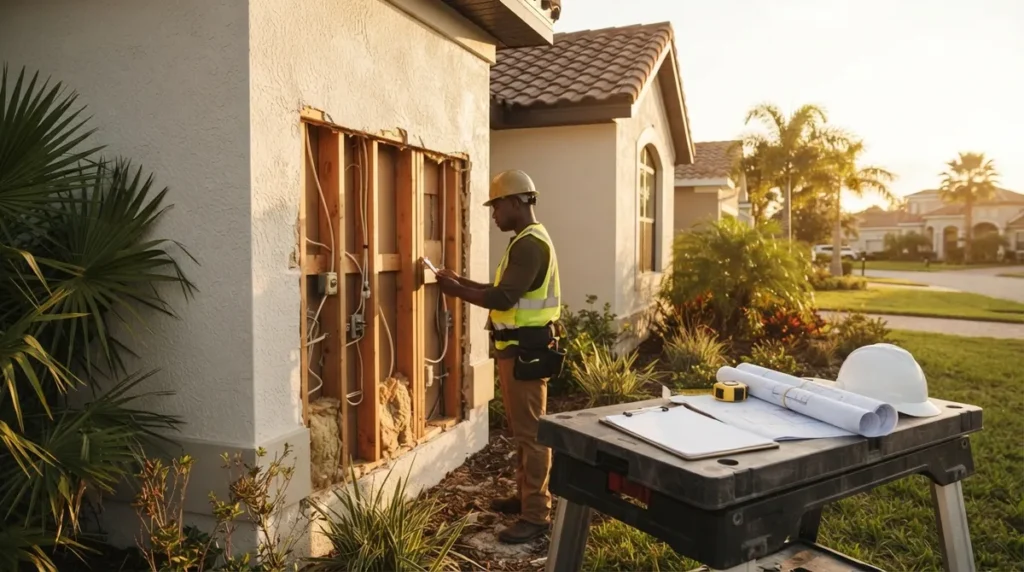
This is the part that makes owners nervous, so let us talk about it plainly. The point of an inspection is to verify the work meets code. If the work is covered by drywall, flooring, insulation, or stucco, inspectors cannot verify what they cannot see.
In many jurisdictions, the building department may require concealed work to be exposed. That could mean cutting small access openings or opening a wall section. After the inspector verifies the work, you repair the openings and schedule reinspection.
Some departments accept alternatives, like an engineer's field verification letter, depending on the work and local policy. It is always worth asking before anyone picks up a saw. If you want to know more about what an inspection visit looks like, take a look at what happens during a Florida ATF site inspection.
What if the Work Does Not Meet Code?
It happens. If something is deficient, the department will list what needs to be corrected. Common fixes include adding fasteners or straps, replacing non-compliant products, correcting wiring, or adding safety features. In rare cases where compliance is not possible, the agency may require modification or removal.
The best defense is to find out early. A pre-application review by an engineer or experienced permitting team can reveal problems before you pay fees or open any walls.
What Does It Cost to Legalize Unpermitted Work in Florida?
Here is where honesty matters most: there is no statewide price tag. Costs depend on the jurisdiction, the scope of work, and whether a violation was issued. Typically, the total can include several pieces:
| Cost Component | What It Covers | Notes |
|---|---|---|
| Standard permit fee | The ordinary fee based on project value or scope | Set by the local jurisdiction |
| Penalties or surcharges | Locally authorized charges for starting without a permit | Varies widely; some places charge none, others charge a multiple |
| Drawings and engineering | As-builts, sealed plans, or engineer letters | Depends on complexity |
| Exposure and repair | Opening and restoring concealed areas | Only if required |
| Corrections | Work needed to meet code | Cannot be known until reviewed |
As one local example, guidance reported for Miami-Dade County describes a possible penalty equal to 100% of normal permit fees when a Notice of Violation has been issued. That is a county-specific example, not a statewide rule, so confirm current charges directly with your jurisdiction. For a deeper look at pricing patterns, see our article on after-the-fact permit costs in Florida.
Special Situations Worth Knowing About
If You Are Buying or Selling
Unpermitted work often surfaces during an inspection, appraisal, or title review. It does not automatically kill a deal, but it can slow things down or give a lender pause. Sellers can often resolve it before closing, and buyers can negotiate a plan. Our realtor and closing support exists for exactly this scenario.
If You Got a Notice of Violation or Stop Work Order
Do not ignore it, and do not keep building. Stop, read the notice carefully, and note any deadlines. Responding quickly and showing good-faith progress usually goes a long way. Our code compliance violations team helps owners respond correctly, and our urgent permit rescue service is built for time-sensitive situations.
If a Contractor Did the Work and Disappeared
Unfortunately, this is common. A permit was promised, never pulled, and now the contractor is unreachable. The legalization process is still available to you as the owner. Keep any contracts, texts, and payment records, since they help document what was done.
If You Are a Contractor or Solar Company
If your crew installed something without proper permitting, the cleanest path is to correct it proactively. Fixing it before an inspector or insurer finds it protects your license and your reputation. General contractors can learn more on our general contractors page, and solar firms can review our solar contractor services.
Common Mistakes to Avoid
After helping owners across the state, a few patterns show up again and again:
- Hiding or covering questionable work. This makes inspections harder and can raise suspicion.
- Applying under the wrong scope. Describing a major addition as a minor repair will backfire at inspection.
- Assuming a neighbor's experience applies to you. Rules differ by jurisdiction, and even by department staff interpretation.
- Skipping the pre-check. Not knowing about an open permit or violation creates surprises later.
- Waiting too long. Problems tend to get more expensive and more stressful with time, especially around a sale or insurance claim.
Do It Yourself or Hire a Permitting Pro?
Simple jobs, like a water heater swap with good photos, may be manageable on your own. Larger or more complicated projects usually benefit from help. A permitting team can tell you which jurisdiction controls, what the department is likely to demand, and how to avoid a second round of comments.
At 1 Contractor Solutions, we act as Florida's outsourced permitting department. We handle after-the-fact and expired permits, prepare the drawings, coordinate plan review, manage revisions and resubmittals, and carry the job through final approval. Because our drafting and engineering are in house, corrections do not stall while we wait on someone else. Want to see what our clients say? Visit us on Google — 1 Contractor Solutions and read the reviews.
If you would like to keep up with permitting tips and Florida updates, you can also follow us on LinkedIn or follow us on Facebook.
A Quick Starting Checklist
If you are ready to take the first step today, here is a simple order of operations:
- Confirm your property's permitting authority.
- Search permit history and look for open permits or notices.
- Take thorough photos and measurements of the work.
- Collect receipts, contractor details, and any existing plans.
- Call the building department or a permitting professional to confirm the process for your type of work.
- Prepare as-builts or engineering if required.
- Submit, schedule inspections, correct anything flagged, and close the permit.
Ready to Make It Official?
Unpermitted work can feel stressful, but it is a solvable problem. The sooner you start, the more options you have, and the less likely a closing, insurance claim, or violation will catch you off guard. The key is a clear process: find the right office, document what exists, address any code gaps, and finish with a passed final inspection.
If you would rather have an experienced team handle the heavy lifting across any of Florida's 67 counties, we are happy to help. Get a free quote today, and we will tell you which jurisdiction controls your project, what it will take, and how fast we can get it moving.
FAQs
How do I get an after-the-fact building permit in Florida?
Start by confirming which city or county building department controls your property, then ask about its after-the-fact process. You will typically submit an application with photos, as-built drawings, and any required engineering, pass inspections, fix anything flagged, and get final approval. Because there is no statewide form, the details depend on your jurisdiction.
Will inspectors make me open walls or ceilings?
Sometimes, yes. If concealed work cannot be verified any other way, the building department may require you to expose it, then repair the openings after inspection. Some jurisdictions accept an engineer's field verification letter as an alternative, so it is smart to ask before cutting anything open.
How much does it cost to legalize unpermitted work in Florida?
There is no single statewide price. You may pay the normal permit fee plus any locally authorized penalty, along with the cost of drawings, engineering, exposure and repair, and any code corrections. For example, one Miami-Dade guidance reportedly allows a penalty of 100% of normal permit fees when a Notice of Violation exists, so always confirm current charges with your local office.
Can I sell a Florida home with unpermitted work?
In many cases you can, but it may complicate the sale because buyers, lenders, appraisers, and insurers may ask questions. Many sellers choose to legalize the work before closing so the transaction runs smoothly. Others disclose it and negotiate, but resolving it first is usually the less stressful route.
What happens if the work does not meet the Florida Building Code?
The building department will typically list the deficiencies, and you will need to correct them and pass reinspection. Most problems can be fixed with upgrades or added structural or electrical details. In rare cases where compliance is not possible, the agency may require modification or removal, which is why an early review is so valuable.
We do this work every day across all 67 Florida counties. Call (866) 314-6931 and we will tell you what your situation actually requires — including when you do not need us.
Related services
Permit Facilitation & Filing
You have a crew scheduled, a client asking for dates, and a permit sitting somewhere in a queue you cannot see. We file it, w…
See the servicePlan Review Coordination
A permit in plan review is not one queue. On a commercial project it can be six queues, each with its own reviewer, its own c…
See the serviceReady to get your permit moving?
One call tells you which jurisdiction controls your project, what it will take, and what it will cost. Most of the time we can scope it on the phone.